
Details
The commercialisation of space applications is leading the drive for more affordable solutions that bring down the cost of space missions. In its wake, RISC-V has emerged as a suitable new processor architecture to supplement, and in some cases replace, current proprietary and less accessible alternatives. Its benefits include its availability, a wide commercial market and the flexibility to customise the architecture as needed. While its space heritage and qualification are still in their early stages, the backing of NASA’s HPSC development effort and interest from other space agencies such as ESA are set to change that.
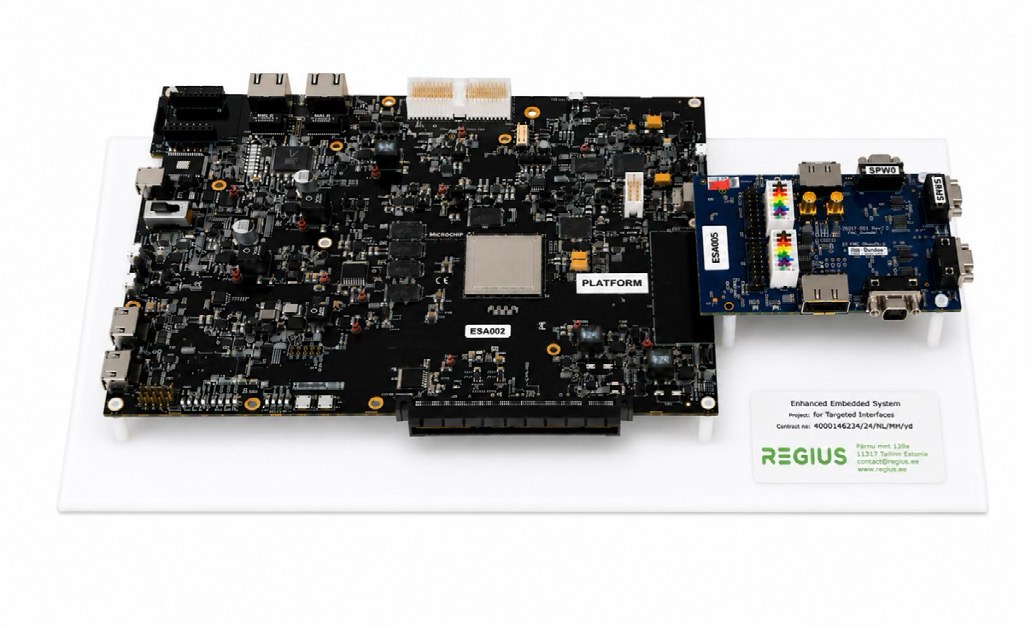
Regius’ project with ESA focused on implementing CAN-FD and SpaceWire IP cores on Microchip’s RISC-V-based PolarFire family of SoC FPGAs. PolarFire SoCs are attractive for space applications due to their low power consumption and their support for the Linux operating system. The latter is attracting growing interest: Linux is a widespread, well-known operating system, and using it on a spacecraft’s on-board computer (OBC) would help bring down development costs. However, little information is available about the performance of the SpaceWire and CAN-FD protocols when they are run from Linux.
In our project, we implemented CAN-FD and SpaceWire IP cores in the PolarFire SoC FPGA fabric and interfaced them with the Linux operating system running on the RISC-V core of the SoC. We demonstrated correct communication of the SpaceWire and CAN-FD IP cores with verified communication equipment and evaluated the performance of both IP cores on the selected PolarFire SoC.